May 19, 2026
How Do Gold and Farmland Actually Differ as Portfolio Assets?


Gold and U.S. farmland are frequently grouped together under the umbrella of real assets. Both are tangible, both are scarce, and both are widely discussed as inflation protection tools and portfolio diversifiers. Despite these surface-level similarities, they serve materially different roles and are driven by fundamentally different economic forces.
Gold is a non-yielding monetary asset whose value is heavily influenced by real (inflation-adjusted) interest rates, macro sentiment, and currency dynamics. Farmland is a productive asset that generates income through agricultural leases and crop production while appreciating over long periods alongside global food demand and constrained land supply.
This analysis examines the structural differences between the two assets to help accredited investors understand how each one functions within a diversified portfolio.
Key Takeaways
- Gold and farmland are both real assets, but their return drivers differ fundamentally. Gold is a non-yielding monetary asset influenced by inflation-adjusted interest rates and macro conditions, while farmland is a productive asset that generates income through agricultural leases and crop production, while its intrinsic value is tied to food demand and land supply dynamics.
- From 1992 through 2025—the longest available period of consistent institutional farmland data—both assets delivered broadly comparable long-term returns but with materially different risk profiles. The NCREIF Farmland Property Index returned approximately 9.8% annualized with 6.9% reported volatility, while gold exhibited 7.7% annualized returns with 17.6% volatility over the same period.
- Gold is highly liquid and can be traded through a standard brokerage account, while farmland is generally a long-term, illiquid asset best suited to investors who can hold through a full agricultural and commodity cycle.
- Gold’s inflation sensitivity is primarily monetary, while farmland’s is tied to agricultural pricing dynamics and food demand.
Neither asset is categorically superior. Allocation decisions depend on time horizon, income objectives, liquidity requirements, and overall portfolio construction goals.
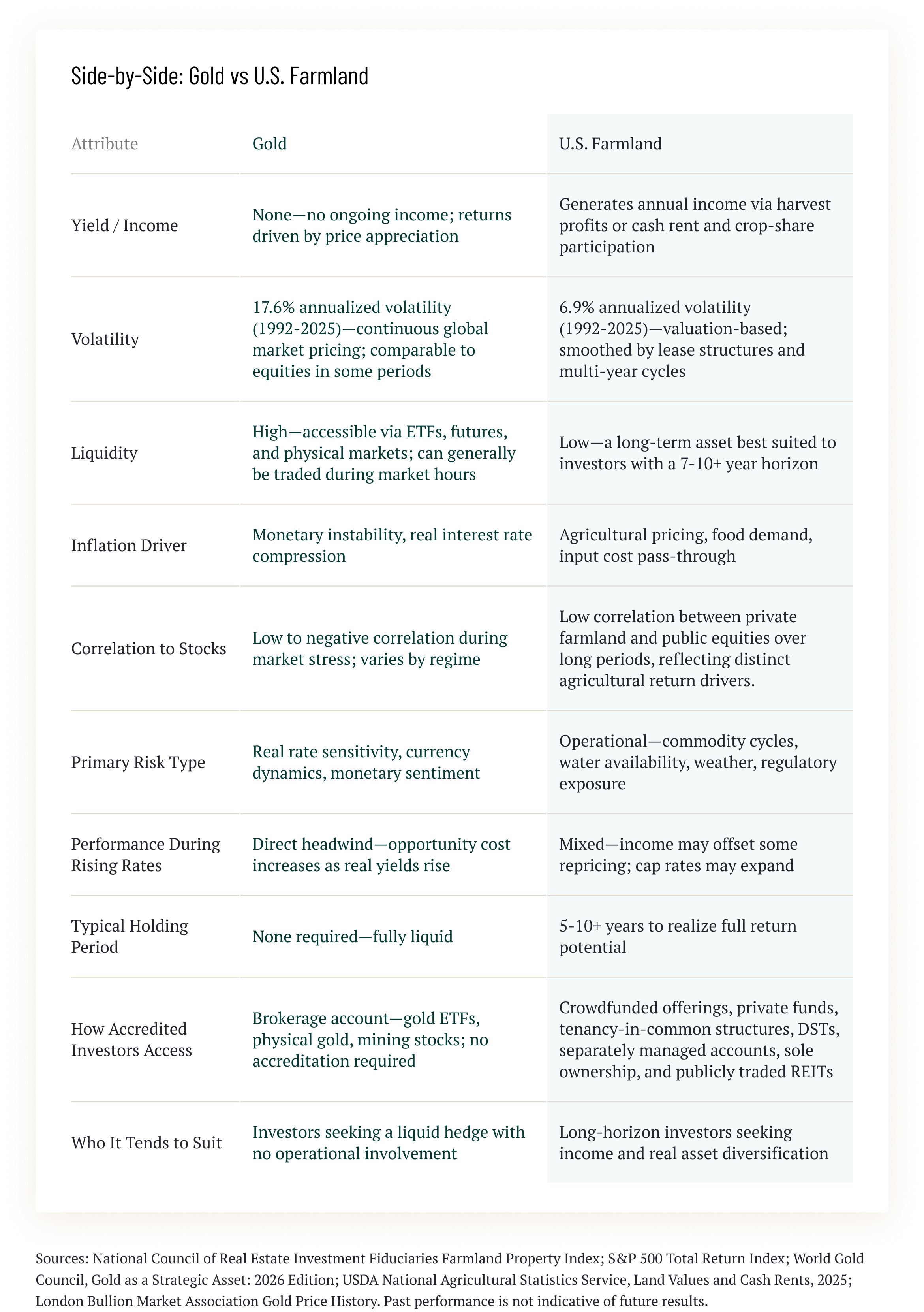
Side-by-Side: Gold vs U.S. Farmland
Why Do Accredited Investors Compare Gold and Farmland?
The comparison arises consistently because both assets share several surface-level characteristics: they are tangible, scarce, and have historically held up better than equities during certain inflationary periods — a pattern reflected in NCREIF farmland return data stretching back to 1992.[1]
Arable land is finite -- and, in many regions, shrinking due to urbanization and environmental pressures. Gold supply is constrained by geology and extraction costs. Both facts support the store-of-value narrative that drives interest in each asset.
Both assets have also shown relatively low correlation to public equities over long measurement periods, making them candidates for portfolio diversification—particularly for investors who feel overexposed to equities through concentrated stock positions, business ownership, or career-related compensation.[2]
However, surface-level similarities mask very different underlying economics. Understanding how each asset actually generates—or does not generate—returns is essential before making an allocation decision.
Do Gold and Farmland Generate Income?
Gold: A Non-Yielding Monetary Asset
Gold does not produce cash flow. It generates no dividends, no rental income, and no distributions of any kind. Total return is entirely dependent on price appreciation.
Because it lacks yield, gold's attractiveness is heavily influenced by real interest rates. When inflation-adjusted Treasury yields rise, the opportunity cost of holding gold increases, and gold typically faces headwinds. When real yields decline or turn negative, gold has historically strengthened—a relationship corroborated by Erb & Harvey (2013), whose research suggests gold performance correlates more closely with real rate movements than with headline CPI levels.
Gold's valuation is sentiment- and macro-driven rather than income-driven. Extended periods of unfavorable real rate conditions—such as the roughly two decades from the early 1980s through 2000 -- can produce near-zero real returns with no income component to cushion the wait.
Farmland: A Productive Asset With Structural Yield
Farmland, by contrast, generates income through agricultural production. Depending on the ownership and operating structure, accredited investors may receive returns through direct farm operations, fixed cash rent arrangements, flexible lease structures tied partly to commodity pricing, or crop-share participation:
- Fixed cash rent: A tenant farmer pays a set dollar amount per acre annually. According to USDA NASS 2025 cash rent data, U.S. cropland rents averaged $161 per acre, with several major agricultural states ranging from roughly $200 to $274 per acre. This structure can provide more predictable annual income, though rent levels vary by region, crop type, irrigation, and land quality.
- Flexible or crop-share structures: Some farmland investments include variable income components tied to crop revenue, commodity prices, or operating performance, providing greater participation in agricultural upside but with increased year-to-year variability.
- Direct operating exposure: In certain structures, investors may participate more directly in farm-level operating income generated from agricultural production and harvest proceeds.
The NCREIF Farmland Index delivered approximately 9.8% annualized total returns from 1992 through 2025, with a meaningful portion generated from annual income rather than land appreciation alone. According to NCREIF data, 2024 marked the first negative annual return in the index’s history (approximately -1.0%), driven largely by declines in permanent cropland’s valuation. This was followed by a modest stabilization in 2025, with total returns of approximately 0.2%, as positive income helped offset continued valuation pressure. Together, these results underscore that farmland performance can vary by crop type, region, and market cycle—and that long-run averages do not guarantee consistent year-to-year returns.
Even through the 2024 downturn and the tepid 2025 performance, the income component of the NCREIF index remained positive—approximately 2.5% in 2024 and over 3% in 2025—demonstrating that farmland’s yield function can persist even during periods of negative or flat appreciation.
How Do Gold and Farmland Respond to Inflation?
Gold and Inflation Regimes
Gold has historically responded to periods of unexpected inflation—particularly when inflation erodes confidence in monetary policy. However, the relationship is not linear.
Periods of moderate, stable inflation have not consistently produced strong gold returns. Research documents that gold's inflation sensitivity is better understood through real interest rate movements than through CPI levels alone -- a finding corroborated by [Erb & Harvey (2013)]. When real yields rise—as they did sharply in 2022—gold can face headwinds even in high-inflation environments, as demonstrated by negative gold returns that year despite U.S. CPI peaking at approximately 9% year-over-year.
Gold's inflation sensitivity is therefore monetary in nature rather than rooted in production economics.
Farmland and Agricultural Pricing Dynamics
Farmland's inflation linkage operates through agricultural fundamentals. As input costs rise -- fuel, fertilizer, labor—those increases can flow through to crop prices over time. Higher crop revenues support higher rental rates, which in turn support higher land valuations.
Historical NCREIF return data show farmland has generated positive returns across multiple economic cycles, though its inflation linkage is indirect and operates through agricultural pricing, rental rates, and land values over time. The transmission mechanism is slower than gold's: lease renegotiations typically happen annually, and land valuations adjust over months and years rather than hours.
The linkage is fundamentally grounded in production economics -- tied to the cost of food supply rather than monetary policy expectations.
Which Asset Is More Volatile: Gold or Farmland?
Gold Volatility
Gold exhibited annualized volatility of approximately 17.6% (1992–2025), comparable to equities in some periods. Gold trades continuously in global markets, with prices reflecting real-time macro repricing by institutional investors, central banks, and retail participants. The 2011 to 2015 drawdown saw gold fall roughly 45% from peak to trough. Performance can be highly cyclical across monetary regimes, producing extended periods of flat or negative returns.
Farmland Volatility
Farmland returns have historically exhibited significantly lower reported volatility (6.9% over 1992–2025) than gold or public equities. Several structural factors contribute:
- The annual income return component provides a return buffer against periods of anemic land appreciation
- Long-term lease structures—typically one to five years—insulate reported valuations from short-term commodity swings
- Appraisal-based valuation methodologies smooth mark-to-market fluctuations, as properties are not continuously repriced in a public market
It is important to note that appraisal-based valuations do not eliminate underlying risk -- they delay its reflection in reported figures. Agricultural markets remain subject to commodity cycles, water constraints, and trade policy shifts. Reported NCREIF volatility figures should be understood within this context.
How Do Gold and Farmland Compare on Liquidity?
Liquidity is one of the most consequential practical differences between these two asset classes for individual investors.
Gold Liquidity
Gold is among the most liquid assets in the world. It can be bought or sold through exchange-traded vehicles (GLD, IAU) in a standard brokerage account during market hours, or accessed through futures and physical markets globally.
Farmland Liquidity
Farmland is a private, transaction-based asset class. Selling a farm parcel requires identifying a qualified buyer, negotiating terms, conducting environmental and title due diligence, navigating water rights, and closing through a legal process—timelines that typically extend 6 to 18 months, and longer in distressed market conditions.
For investors with long time horizons and stable liquidity in other parts of their portfolio, farmland's illiquidity may be an acceptable tradeoff for its income and diversification characteristics. For investors who may need to access capital within five years, the illiquidity profile of farmland is a material constraint that warrants careful consideration before committing capital.
How Do Gold and Farmland Behave During Monetary Tightening Cycles?
Gold and farmland typically respond differently to rising interest rates because their return drivers are fundamentally different. Gold is highly sensitive to real interest rates and monetary conditions, while farmland's performance is influenced by both valuation dynamics and agricultural income generation.
Gold During Tightening Cycles
Rising real interest rates have historically created headwinds for gold. As inflation-adjusted Treasury yields increase, the opportunity cost of holding a non-yielding asset rises. The 2022 tightening cycle reflects this dynamic, as real yields moved sharply from negative to positive territory.
Farmland During Tightening Cycles
Farmland's response to tightening cycles operates differently. Higher interest rates can contribute to capitalization rate expansion, which places downward pressure on farmland valuations. However, farmland includes an income component that gold lacks. When crop prices remain elevated during tightening cycles—as they did in 2022 due to supply disruptions—agricultural income can partially offset valuation pressure from expanding cap rates.
At the same time, farmland income has historically remained positive across market cycles, meaning that income may help mitigate valuation pressure depending on crop prices, lease structures, and operating conditions.
Neither asset is immune to rising rates. Gold's vulnerability is generally more direct and immediate, while farmland's income generation may mitigate—but not fully eliminate—the repricing effect.
What Are the Primary Risks of Each Asset?
Gold Risks
- Price volatility: Gold exhibited annualized volatility of 17.6% from 1992 through 2025, with multi-year drawdowns exceeding 40%.
- Extended underperformance: gold delivered near-zero real returns from the early 1980s through 2000—approximately two decades
- Real rate sensitivity: positive real yields create sustained headwinds with no income to offset
- No income: a zero-yield asset produces no return during periods of price stagnation
- Currency dynamics: U.S. dollar strength historically pressures gold prices
Farmland Risks
- Commodity price risk: tenant ability to pay rent and renew leases is partly dependent on crop prices outside the investor's control
- Input cost pressure: rising costs for fertilizer, fuel, labor, water, and agricultural inputs can compress farm operating margins, particularly during periods when crop prices fail to keep pace
- Weather and climate variability: drought, flooding, and temperature extremes affect crop yields and, over time, regional land values
- Water availability: access to irrigation is increasingly a valuation and operational risk, particularly in the Western U.S.
- Illiquidity: the inability to exit quickly in adverse conditions is a structural feature, not just a temporary friction
- Operator and tenant quality: farmland returns are materially affected by the competency of farm operators and the quality of lease structures
- Regulatory exposure: land use law, environmental regulations, and water policy can shift in ways that affect operations and valuation
- Regional concentration: farmland is inherently geographically specific; meaningful diversification requires owning across multiple markets
How Do Accredited Investors Typically Approach Allocation to These Assets?
Gold and farmland are not interchangeable portfolio tools. They serve different structural roles, and the decision between them—or whether to include both—depends on an investor's specific objectives, constraints, and time horizon.
Gold has historically served as a liquid macro hedge, responding to monetary instability and real rate compression. It carries no income, no operational complexity, and no lockup period. Investors who prioritize capital flexibility or who hold gold as a tail-risk position in a broader portfolio can adjust exposure quickly.
Farmland has historically provided income alongside long-term appreciation tied to agricultural fundamentals. Its low correlation to public equities stems from return drivers—crop prices, lease rates, food demand—that are structurally distinct from corporate earnings cycles.
Accredited investors evaluating farmland for the first time often consider it alongside other income-producing real assets as part of a diversified real asset allocation. The vehicle through which farmland is accessed—crowdfunded offerings, private funds, tenancy-in-common structures, DSTs, separately managed accounts, sole ownership, or publicly traded REITs—significantly affects liquidity, minimum investment, and the degree of public market correlation. Regional land values vary materially across agricultural markets and should inform direct acquisition decisions.
Investors considering either asset may wish to evaluate their liquidity requirements, income objectives, time horizon, and overall portfolio structure before making allocation decisions, in consultation with a qualified financial advisor.
Frequently Asked Questions
Is farmland a better investment than gold for an accredited investor?
Neither asset is categorically superior. Gold and farmland have different return drivers, liquidity profiles, income characteristics, and risk types. World Gold Council research and NCREIF performance data both support the view that these assets serve different portfolio functions. Suitability depends on an investor's time horizon, income objectives, and liquidity requirements -- factors best evaluated in consultation with a qualified advisor.
Which is more volatile -- gold or farmland?
Gold has historically exhibited annualized volatility of approximately 17.6% from 1992-2025 and multi-year drawdowns exceeding 40%. Farmland, as measured by the NCREIF Farmland Index, reported materially lower volatility over the same period at approximately 6.9%, reflecting the stabilizing effect of long-term leases, income generation, and appraisal-based valuation methodologies.
How do gold and farmland perform during inflation?
Research documents that gold responds primarily to real interest rate movements rather than headline CPI—a finding corroborated by Erb & Harvey (2013). Farmland's inflation linkage runs through agricultural pricing dynamics: rising input costs can push crop revenues higher, supporting rental rates and land values over time. The 2022 CPI record—when gold underperformed despite elevated inflation —illustrates that gold's inflation hedge properties are conditional rather than automatic.
Does farmland generate income for investors?
Yes. Farmland investors typically receive annual income through fixed cash rent or crop-share arrangements. Cash rents in prime Midwest markets have historically run $150 to $300 or more per acre annually. The NCREIF Farmland Index shows income comprising a meaningful share of the index's approximately 10% annualized total return since 1992. Notably, even in 2024—the first year the index posted a negative total return—the income component remained positive at 2.49%, illustrating that farmland's yield function can persist through periods of capital depreciation. Gold produces no income of any kind.
Is gold more liquid than farmland?
Gold trades in some of the deepest and most liquid markets in the world, accessible through ETFs and futures in standard brokerage accounts. Farmland is a private, transaction-based asset where sales typically take 6 to 18 months to complete, involve legal due diligence on title and water rights, and are subject to regional market conditions. Liquidity is one of the most consequential practical differences between the two asset classes for individual investors.
How did farmland perform during the 2008 financial crisis?
The NCREIF Farmland Index continued generating positive total returns through 2008 and 2009, supported by its income component and the structural separation of agricultural fundamentals from financial market dynamics, including the residential real estate market. Gold also performed well during that period as investors sought safe havens. Both assets demonstrated diversification characteristics during the crisis—gold through its monetary safe-haven status, farmland through its income stream and disconnection from corporate earnings cycles.
Is farmland appropriate for a retirement-oriented portfolio?
Farmland's income component and historically low correlation to equities—documented over more than three decades of index data—are characteristics that can align with long-term, income-oriented portfolio objectives. However, farmland's illiquidity may dim its suitability for investors who may need to access capital within five to seven years. Accredited investors considering farmland for retirement portfolios may wish to evaluate liquidity requirements across their full financial picture and consult with a qualified advisor.
How does farmland compare to gold as a long-term inflation hedge?
NCREIF data show farmland generating positive real returns across a wide range of inflationary environments, driven by agricultural income and land value appreciation linked to food production economics. Research documents that gold's inflation linkage is more conditional—strongest during monetary instability and real rate compression, and less consistent during moderate inflation with stable or rising real yields. Erb & Harvey (2013) corroborate this finding.
What is the NCREIF Farmland Index?
The NCREIF Farmland Index is the primary benchmark for U.S. institutional farmland investment performance, maintained by the National Council of Real Estate Investment Fiduciaries. It tracks quarterly returns on agricultural properties held by institutional investors, reporting both income and appreciation components separately. As of Q1 2026, the index included 1,571 institutional farmland properties spanning annual and permanent cropland across the United States, representing approximately $16 billion in market value. The index is widely cited as the most comprehensive long-run performance record available for the U.S. farmland asset class.
How does water access affect farmland valuation?
Water access is an increasingly critical variable in farmland valuation, particularly in the Western U.S. Properties with senior water rights or reliable groundwater access command significant premiums and carry lower long-term operational risk. Aquifer depletion and evolving state water law have made water rights analysis an essential component of farmland due diligence. Rain-fed farmland in the Midwest and Southeast is generally considered to carry lower water-related risk than irrigated Western properties.
Can an accredited investor hold both gold and farmland?
Yes. World Gold Council portfolio research and NCREIF return data both support the view that gold and farmland have sufficiently different return drivers to function as complementary rather than redundant holdings within a diversified real asset allocation. Gold contributes liquid monetary hedge exposure; farmland contributes income and agricultural inflation linkage. The appropriate sizing of each position depends on the investor's liquidity needs, time horizon, and overall portfolio construction objectives.
How does farmland's correlation to stocks compare to gold's correlation to stocks?
Gold's decorrelation from equities tends to be strongest during acute market stress events. Farmland's low correlation is more structurally persistent across varied market environments, reflecting the fundamental disconnection between agricultural income cycles and corporate earnings cycles. Investors building diversified portfolios may find both assets provide diversification benefits, with the nature of that diversification differing by market regime.
National Council of Real Estate Investment Fiduciaries (NCREIF), Farmland Property Index, member data, 1992–2025. ↩︎
National Council of Real Estate Investment Fiduciaries Farmland Property Index; S&P 500 Total Return Index; World Gold Council, Gold as a Strategic Asset: 2026 Edition; USDA National Agricultural Statistics Service, Land Values and Cash Rents, 2025; London Bullion Market Association Gold Price History. Past performance is not indicative of future results. ↩︎
Click here to see farmland's historical performance, visit our FAQ to learn more about investing with FarmTogether, or get started today by visiting ways to invest.
Disclaimer: FarmTogether is not a registered broker-dealer, investment advisor or investment manager. FarmTogether does not provide tax, legal or investment advice. This material has been prepared for informational and educational purposes only. You should consult your own tax, legal and investment advisors before engaging in any transaction.
Was this article helpful?